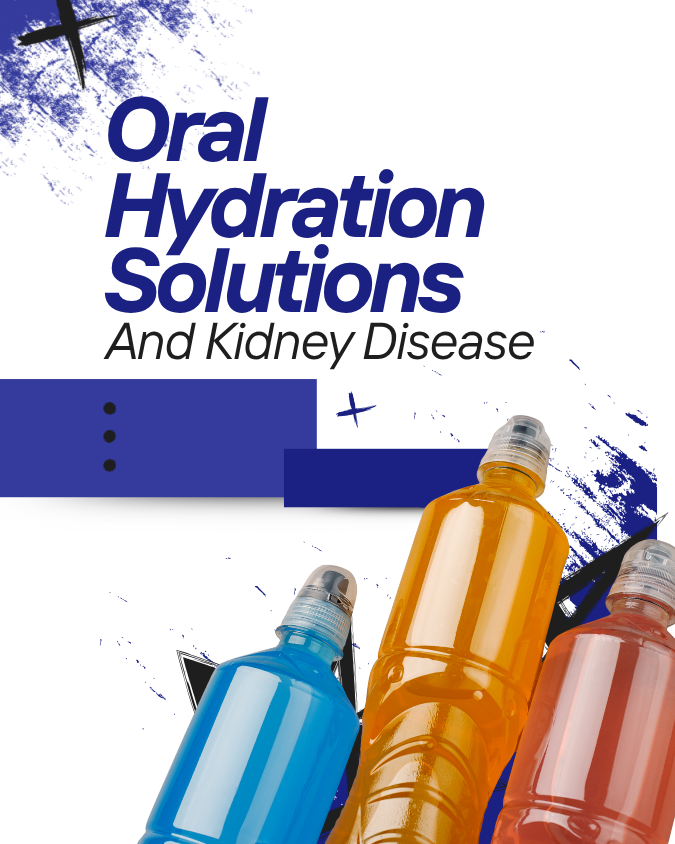
Oral rehydration solutions (ORS) are considered a life-saving therapy for preventing dehydration during episodes of diarrhea. But if you work with people living with kidney disease, you might be wondering: Are ORS safe for my patients?
This question is particularly important because standard ORS contain both sodium and potassium, which can be concerns for some people with kidney disease.
How do ORS work?
ORS help prevent dehydration by leveraging the sodium-glucose co-transporter mechanism (SGLT1) in the small intestine. When sodium and glucose are absorbed together, water follows, increasing the absorption of water and electrolytes.
Standard ORS use a specific concentration of electrolytes and glucose to take advantage of this mechanism. The World Health Organization (WHO) low-osmolarity ORS formulation contains approximately:
- Sodium: 75 mEq/L
- Glucose: 75 mmol/L
- Potassium: 20 mEq/L
- Chloride: 65 mEq/L
- Citrate: 10 mmol/L
- Osmolarity: ~245 mOsm/L
Why might ORS be inappropriate for people with CKD?
The main concerns with using standard ORS in people with CKD are related to:
- Hyperkalemia from the potassium content
- Fluid overload, particularly in people with reduced or no urine output
- Sodium load, which may be a concern for people with edema or uncontrolled blood pressure
So, should people with CKD avoid ORS altogether?
Not necessarily.
How should ORS be adapted for the CKD population?
According to the authors of this paper, there is a CKD stage-specific approach to tailoring the electrolyte composition of ORS for people living with CKD.
The following table is reproduced from that paper. The authors emphasize that these values should not be considered absolute prescriptions, but rather as a guide to help minimize risk when using ORS in people with CKD.
| Component | WHO ORS | Stage 1–3 CKD | Stage 4 CKD | Stage 5 CKD (on or off dialysis) |
|---|---|---|---|---|
| Sodium | 75 mEq/L | 50–75 mEq/L | 40–60 mEq/L | 30–50 mEq/L |
| Potassium | 20 mEq/L | 10–15 mEq/L | ≤10 mEq/L | 0–5 mEq/L |
| Glucose | 75 mmol/L | 50–75 mmol/L | 50–60 mmol/L | 50–60 mmol/L |
| Chloride | 65 mEq/L | 45–60 mEq/L | 40–50 mEq/L | 35–45 mEq/L |
| Citrate | 10 mmol/L | 8–10 mmol/L | 8–10 mmol/L | 8–10 mmol/L |
| Osmolarity | ~245 mOsm/L | ~220 mOsm/L | ~200–210 mOsm/L | ~180–200 mOsm/L |
| Recommended intake | 75–100 mL/kg/day | 50–75 mL/kg/day, based on losses | 30–60 mL/kg/day, guided by output | 20–40 mL/kg/day |
The goal isn’t necessarily to avoid ORS in people with CKD. Instead, the authors suggest that the composition and amount may need to be individualized based on CKD stage, potassium level, urine output, volume status, blood pressure and ongoing fluid losses.
When should ORS be used?
The authors highlight several situations where ORS may be useful, including:
- Vomiting
- Diarrhea
- Poor oral intake
- Potentially, post-dialysis fluid replacement
- Fluid losses associated with hot climates
Of course, the degree of fluid replacement required will depend on the individual and the cause and severity of the fluid losses.
What should be monitored when ORS are used?
For people with CKD, using ORS isn’t simply about choosing a recipe. Monitoring is also important.
Monitor serum potassium
For someone with hyperkalemia, a potassium-free ORS formulation may be appropriate.
The authors suggest considering a 0 mEq/L potassium formulation when serum potassium is >5.5 mmol/L.
Monitor volume status
Fluid replacement needs to be balanced against the risk of fluid overload.
The authors suggest keeping the sodium concentration below 60 mEq/L in people with edema or hypertension.
Monitor urine output
Urine output becomes particularly important in people with advanced CKD.
For people who are anuric or oliguric, the authors suggest calculating fluid requirements based on urine output plus insensible losses:
Total intake = urine output + insensible losses (~400–600 mL/day)
This calculation would need to be individualized based on the clinical situation and other sources of fluid intake.
Monitor daily weights and blood pressure
Daily weights and blood pressure can provide useful information about changes in volume status.
Fluid recommendations and ORS composition may need to be adjusted based on these trends.
Will changing the composition of ORS affect their ability to leverage SGLT1?
This was one of the questions I had while reading the paper.
If we reduce the sodium, potassium and other electrolytes in ORS, does that somehow reduce their ability to take advantage of the sodium-glucose transport mechanism?
Unfortunately, this wasn’t discussed in the article.
So I kept digging and found this fascinating review on the history of ORS.
The authors describe how the composition of ORS has changed over time. Compared with the original WHO formulation developed in the 1970s, modern ORS formulations already have a lower osmolality.
More importantly, the review highlights that sodium and glucose are the key components responsible for stimulating sodium-glucose transport in the intestine. Potassium and the other components serve different purposes.
This suggests that modifying some of the other components of an ORS formulation doesn’t necessarily eliminate its ability to promote fluid absorption.
In fact, according to Emergency BC, potassium is included primarily to replace potassium losses, while citrate is included to help address metabolic acidosis.
This raises an interesting clinical question: Could potassium be removed from an ORS formulation for someone with hyperkalemia while still maintaining the sodium-glucose mechanism needed for fluid absorption?
The authors of the CKD paper suggest that potassium concentrations can be reduced substantially as CKD progresses, including to 0–5 mEq/L in stage 5 CKD.
That seems particularly relevant for people with hyperkalemia.
Can sports drinks such as Gatorade® be used as ORS?
No—not as a substitute for a properly formulated ORS.
Sports drinks are designed for a different purpose and generally have a higher osmolality and lower electrolyte concentrations than standard ORS formulations.
Some sports drinks have osmolalities in the range of 330–730 mOsm/L, compared with approximately 245 mOsm/L for standard WHO ORS.
The higher osmolality and different electrolyte composition mean that sports drinks aren’t considered an appropriate replacement for ORS when treating or preventing dehydration associated with diarrhea.
Do ORS reduce diarrhea?
This may sound counterintuitive, but ORS don’t actually stop diarrhea.
Their primary purpose is to prevent or treat dehydration resulting from fluid losses during diarrhea.
There is ongoing research into whether different oral rehydration formulations could have additional effects on diarrhea symptoms, but preventing dehydration remains the primary purpose of ORS.
Takeaways
- ORS are a life-saving strategy for preventing and treating dehydration during episodes of diarrhea and vomiting.
- The composition of ORS has changed over time, including reductions in osmolality compared with the original WHO formulations.
- Sodium and glucose are the key ingredients involved in leveraging sodium-glucose transport in the intestine to promote water absorption.
- For people with kidney disease, the sodium and potassium concentrations in ORS may need to be modified to reduce the risk of hyperkalemia, fluid overload and excessive sodium intake.
- Potassium does not appear to be required for the sodium-glucose transport mechanism itself, and potassium concentrations can be substantially reduced in ORS formulations for people with advanced CKD.
- A potassium-free formulation may be particularly relevant for people with hyperkalemia.
- Sodium cannot simply be removed from an ORS, because sodium is an essential part of the sodium-glucose transport mechanism that promotes fluid absorption.
- For people with CKD, ORS use should be individualized based on serum potassium, urine output, volume status, blood pressure and the amount of ongoing fluid loss.
For me, the most interesting takeaway is that “ORS” doesn’t necessarily have to mean one standard recipe. The formulation can be adapted—and for people living with kidney disease, that may be important for balancing effective rehydration with the risks of potassium, sodium and fluid overload.